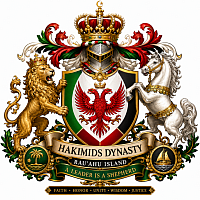
THE HAKIMIDS DYNASTY

Throne of the Sultan
History of the Hakimids
The modern Hakimids Dynasty was established under the leadership of Abdul Hakim Nooruddeen Apani'ai, also known as Sultan Hakim. According to the family's own account, the Hakimids dynastic vision emerged in 2012, followed by the formal establishment of the Sultanate institution in 2018.
The Hakimids identify themselves as a modern family dynasty associated with the Rau'ahu Royal House and the traditional heritage of the Ārai Peninsula in the Solomon Islands.
The family's modern identity combines ancestral tradition, genealogy, religious faith, cultural heritage, and a commitment to leadership and service.
The modern institution, however, presents itself as connected to a much older ancestral story. That story reaches back to the traditional history of Rau'ahu.
The Hakimids Dynasty, is a modern religious dynasty from what is now Ārai Peninsula, on the north-western tip of Small Mala’ita island in the Solomon Islands. It is a revival dynasty, reviving the ancient Rau'ahu Royal House, and thus currently controls the island of Rau’ahu and parts of the coastal shores of Ārai Peninsula from 2018 to present.
The Hakimids Dynasty was founded by Abdul Hakim Nooruddeen Apani’ai, a Muslim scholar and Ex–Missionary belonging to Islam Ahmadiyya. Hakim is the son of Horahanua Iuhanramo, an expert local historian from one of the chief tribes, called Karenipuri tribe, that control Paurahaomae, northern region of Small Mala'ita Island, in Solomon Islands.
Hakimids family are the children and future descendants of Abdul Hakim Nooruddeen Apani'ai. The Hakimids Dynasty is an offshoot from the chief tribe Karenipuri of Paurahaomae.
The Hakimids family traces ancestry to a local ruling family once associated with what the Hakimids call the ancient “Rau’ahu Royal House”. According to the Hakimids, this ruling family lived at Rau’ahu or Pyramid island, which is situated on the northern Ārai Peninsula, Small Mala’ita in the Solomon Islands. Based on the original preserved genealogical documents, the head or leader of this ruling family is known as Poro Ūmenmatara, the honored progenitor of Paurahaomae region and the areas thereabout.
Origin of Rau'ahu
The historical and traditional origin of Rau’ahu—the place associated with the Hakimids Dynasty—we can investigate it from several layers:
1. Rau’ahu Is A Real Geographical Place
Rau’ahu Island is located geographically in Malaita Province, Solomon Islands. External geographical databases also give it the alternative names Pyramid Island and Pyramid Rock, with coordinates around 9°19′S, 161°20′E.
So the name Rau’ahu is not simply a modern Hakimids invention. The island or place is independently recorded.
2. The Traditional Origin Of Rau’ahu
According to the historical account by the Hakimids Royal House, the earliest settlement tradition begins approximately 1,860 years ago with an ancestor named Ūtai Saso Ou’ou Masike.
The tradition says that Ūtai Saso Ou’ou Masike migrated on foot from Hunuri in central Small Malaita toward the Ārai Peninsula. The protected bays and abundant marine resources of Ārai attracted the settlers, and an early settlement was established there.
The account therefore presents Rau’ahu as part of a much older Small Malaita → Ārai ancestral migration, rather than as an isolated settlement appearing suddenly.
3. The First Known Ancestor Associated Specifically With Rau’ahu
The Royal House history identifies Poro Ūmenmatara as the earliest known ancestor who discovered and inhabited Rau’ahu itself.
Michael Horahanua Iuhanramo (Al-Kindi) is an expert local historian of Small Mala’ita, who holds the Title of Ārai land. According to him, the first historical known ancestor to have discovered and inhabited the island of Rau’ahu was Poro Ūmenmatara.
Al-Kindi related that Poro Ūmenmatara was the great-great-grandson of Ūtai Saso Ou’ou Masike. He is reported to have married to Hu’a Nuru’urau, who is described as the daughter of Poro Haunikara Ou’ou of Niaraha’u (Sa’a), southern tip of Small Mala’ita island, who was probably a chief or a supreme warrior in that region.
Poro Ūmenmatara is said to have lived and died on Rau’ahu and to have been buried there at Heranimanu. Poro Ūmenmatara was able to produce nine children, whose descendants would later populated Ārai Peninsula and the surrounding areas.
Their nine children are traditionally remembered as:
- Tahemanu Ou’ou
- Tahemanu Rourohu
- Nari’ai Mane Paina
- Nari’ai Mane Masike
- Kawaha
- Hu’auri
- Nunu’anawe Paina
- Nunu’anawe Masike
- Hu’a Āroniwai
The tradition regards their descendants as important ancestors of later communities throughout Ārai and surrounding areas.
4. A Possible Historical Structure
The tradition can therefore be represented approximately as:
Hunuri / central Small Malaita
↓
Ūtai Saso Ou’ou Masike
↓
Migration toward Ārai
↓
Early Ārai settlement
↓
Poro Ūmenmatara
↓
Settlement of Rau’ahu
↓
Nine children and their descendants
↓
Ārai clans and communities
↓
Rau’ahu Royal House tradition
↓
Hakimids Dynasty
That is the traditional genealogical model, not yet a scientifically established archaeological chronology.
5. The Rau’ahu Royal House
The Hakimids historical account describes Rau’ahu as having subsequently developed into a center of regional authority. It claims that rulers associated with Rau’ahu exercised influence over parts of Ārai, northern Paurahaomae and nearby islands. It also preserves the tradition of Haimā’i Paina, remembered as the last pre-colonial ruler of the Rau’ahu Royal House, who supposedly died in the battle of Hanuahansia.
Note:
The geographical existence of Rau’ahu is independently documented; the detailed ancestral chronology and royal succession currently come primarily from local oral or Hakimids traditions.
That distinction actually makes the historical project stronger because we don't need to present tradition as if it were already proven archaeology.
6. Origin Of The Name "Rau'ahu"
The most interesting question is where the name “Rau’ahu” itself originated.
I'm yet to find a reliable external linguistic source that establishes the etymology of Rau’ahu. Therefore, I would not claim a definitive meaning for the word at this stage.
That would allow us to build a much more rigorous “History and Origin of Rau’ahu”, separating documented evidence, oral tradition, genealogy, and later Hakimids historical interpretation.
In the pre-colonial era, Ārai was a major regional power, and a fierce rival of nearby tribes and kingdoms (called "iora"), of Small Mala'ita, East Are'are, including parts of North Mala'ita and Ulawa island. The Rulers of Rau'ahu ruled most of northern Paurahaomae, and control nearby islands, including, Hauhāri'i (Sail Rock), Ānuta Ni'ia and many of the islands off the coast of Ārai, which are no longer exist today.
According to the Hakimids, the last pre-colonial ruler and great warrior of the Rau’ahu Royal House, particularly in Ārai Peninsula, is said to have been Haimā’i Paina, who is reported to have lost his life during the tribal Battle of Hanuahansia. The historical name ‘Hanuahansia’ (well pronounced as, Hanuahani-si’a) literally mean “place of axe”, depicting Ārai background as a battle field, and reflecting the major traditional tools commonly used in fight – before and during the battle of Hanuahansia.
Hakimids Dynasty, as a revival of the Rau'ahu Royal House, presently holds control of the island of Rau'ahu, including parts of the mainland Ārai, such as Tawaroto (Cordoba) and nearby coasts, and Āhu'i (Istanbul).
Ārai Peninsula Heritage
The Ārai Peninsula of Small Mala’ita stands today as a quiet landscape, but beneath its calm surface lies one of the oldest human histories in the region. The first settlement began around 1,860 years ago, during the migration of Ūtai Saso Ou’ou Masike, who crossed the land by foot from Hunuri, in central Small Mala’ita, to the Land of Ārai. Drawn by the peninsula’s protected bays and rich marine life, he established their settlement and named it Hunuri (after Hunuri Tōhi). Thus, Hunuri became the earliest community in Ārai Peninsula.
The Ārai Peninsula forms one of the ancient strongholds of human settlement in Small Malaita, a region where the lineages of many present-day families trace their origin. For over one thousand years, its shores have witnessed the rise of clans, the forging of alliances, and the shaping of a proud cultural identity.
From the earliest ancestors who landed on its coves, the peninsula grew into a center of leadership and cultural authority. Clan custodians guarded its sacred stones, ancestral shrines, and ritual grounds, maintaining traditions handed down through unbroken generations. Through oceans and centuries, Ārai remained a place where genealogies were preserved, where chiefs and elders were shaped, and where sacred responsibilities were passed from parent to child.
The Ārai people engaged in regional diplomacy long before colonial influence, forming alliances with Sa’a (Niaraha’u), Po’otoro, Ōrumarau, and surrounding districts through marriage, ceremonial exchange, and trade. These relationships bound the peninsula to the wider social world of Small Malaita.
Today, the story of Ārai stands as a royal narrative of resilience — a land shaped by ancestors, strengthened by generations, and honored by all who trace their heritage to its sacred shores. Ārai stands as a testament to its long human journey. It remains not only a geographic space but a living record of ancestry, memory, and cultural resilience. The Ārai people are maintaining continuity with their ancestral identity. The land remained a foundation of pride, memory, and authority.
Founding of the Hakimids Dynasty
Hakimids Dynasty is a reflection of Rau'ahu Sultanate (Tolo: سلطانن رَوْأَهُن, Sultanin Rau'ahun, sometimes Rau'ahu Royal House. It is a religious sultanate in what is now Ārai Peninsula, centered on Rau'ahu island, in northern Small Mala'ita, Solomon Islands. It was established by the Hakimids; its ruler carrying the title "Sultan" — Authority or Power.
The Hakimids Dynasty was founded by Abdul Hakīm Nooruddīn Apani'ai, son of Al-Kindi (Michael Horahanua Iuhaniramo), in 1433 AH (2012 CE), when he was 24 years old. It was not until 16 Rabīʿ ath-Thānī 1440 AH (December 24, 2018), that the dynasty was firmly established, after Hakīm had declared himself as the first Sultan of the dynasty – nearly months after his second marriage.
Hakimids Dynasty is the revival of the ancient Rau'ahu Royal House, whose Kingdom is known as Warumanihura'aro. Hakimids Dynasty is thus a reflection of Warumanihura'aro.
Warumanihura'aro literally mean 'Eight Rainbows'; it was a local Kingdom that ruled Ārai Peninsula for centuries, and that their ruling was lapsed with the mertyrdom of Haimā'i Paina, the last warrior Ruler of the Warumanihura'aro Kingdom, during the tribal battle of Hanuahansia, central Ārai.
Hakīm – a Muslim scholar and former Missionary In-Charge for the Ahmadiyya Muslim Jama'at Solomon Islands (2016—2018) – assumed religious authority in northern Ārai, in small Mala'ita, Solomon Islands.
In year 2000, at the age of 12, Hakīm already had this dream that one day he is going to build his home in Rau'ahu island. This is due to the fact that on many occasions Hakīm and his brothers, Muhammad Hataimarau and Sulayman Tahisimae, would acompany their father, Al-Kindi, on trips to Rau'ahu and other parts of Ārai peninsula – taking part in discovering land and sea boundaries.
In 2012, Hakim, along with his brothers: Hamza Roro'i and Adam Tahisimae (first cousin), visited Rau'ahu, exploring the island further; since then he had a firm plan to establish his home and settle on the island.
In 2018, Hakīm claimed that he had a series of inspiring dreams (same dream was repeated 3 times) in which "he had seen that he was building a huge magnificent Palace in Rau'ahu island". And he had also narrated another dream, that:
"One night in a state of dream I saw myself standing at Tawaroto point and looking across to Rau'ahu island. To my surprise, I saw that the entire island is covered with magnificent Palaces. I can still recall the blue, red, green, and golden colors of those Palaces."
On 16 Rabī' ath-Thānī 1440 AH (December 24, 2018), the exact day he was sucked from his Missionary duty by the Ahmadiyya Muslim Jama'at, Hakīm declared himself as the Sultan of an independent Hakimids community, legalizing the Sultanate system as a cultural institution. Under this cercumstances the Sultanate of Rau'ahu was thus established, and as a matter of fact it is to be continued deep into the future.
In early 2020, Hakīm re-afirm and declares on social media (Facebook) that he is the Sultan of the revival dynasty. He announced:
"TODAY, I DECLARE THAT I AM THE SULTAN OF THE HAKIMIDS DYNASTY."
He added:
"AFTER ME, MY SON MUHAMMAD HAKĪM ŪMENMATARA SHALL BE THE NEXT SULTAN."
In February 2021, Tawaroto (now Cordoba) on the mainland coast, was also claimed by Hakīm and immediately established himself in his former ancestral territories.
In December of the same year, Hakīm discovered yet another new location, Āhu'i (now Istanbul) where he set up his first resident, known as Sultan Resident, and which would later become an administrative sub-centre.
Moreover, Hakīm is reported to have seen another inspiring dream about Rau'ahu island, in which he had a converse with Hu'a Nuru'urau, the wife of Poro Ūmenmatara of Rau'ahu. The dream is recorded as follows:
"On Saturday towards morning, 24 June 2023, I had a great dream in which I confronted one of my female ancestors, Hu'a Nuru’urau, the wife of Poro Ūmenmatara of Rau’ahu. She was a light skin woman by nature and tall in status. I had a discourse with her at Rau’ahu island. I was walking up the hill from the seaside (landing bay) and suddenly she appeared and was following me in my rare, shaking her head as an indication of disagreement. Upon this, I continued to plead her until she finally agreed and approached me, and sat with me, about 1 meter, on my left. While we were both conversing, she said to me, "If you want to see Poro Ūmenmatara, I can then show him to you now; for he is a holy man". It was at this point that I woke up, pondering over the dream."
It was on the bases of these dreams that Hakīm finally made up his mind to settle on the island and administer it under Hakimids authority. Now his plan to establish the Islamic Centre on the island is in progress. The work – clearance – has already started on the site.
Meaning of the name "Hakimids"
Royal Succession/ Family Leadership
Reason for Creating the Dynasty
Aim & Objective
The primary objective of establishing the dynasty was to spread the beautiful religion of Islam far and wide, throughout the the country, and with the aim of pulling the Ārai peninsula under the Islamic influence. It was created to preserve Ārai traditional heritage, promote Islamic influence, and unite local clans under a symbolic royal structure, connected to both indigenous and Islamic traditions.
History of Ārai and Rau'ahu
The Ārai Peninsula of Small Mala’ita stands today as a quiet landscape, but beneath its calm surface lies one of the oldest human histories in the region.
The first settlement began around 1,860 years ago, during the migration of Ūtai Saso Ou’ou Masike, who crossed the land by foot from Hunuri, in central Small Mala’ita, to the Land of Ārai. Drawn by the peninsula’s protected bays and rich marine life, he established their settlement and named it Hunuri (after Hunuri Tōhi). Thus, Hunuri became the earliest community in Ārai Peninsula.
The Ārai Peninsula forms one of the ancient strongholds of human settlement in Small Malaita, a region where the lineages of many present-day families trace their origin. For over one thousand years, its shores have witnessed the rise of clans, the forging of alliances, and the shaping of a proud cultural identity.
From the earliest ancestors who landed on its coves, the peninsula grew into a center of leadership and cultural authority. Clan custodians guarded its sacred stones, ancestral shrines, and ritual grounds, maintaining traditions handed down through unbroken generations. Through oceans and centuries, Ārai remained a place where genealogies were preserved, where chiefs and elders were shaped, and where sacred responsibilities were passed from parent to child.
The Ārai people engaged in regional diplomacy long before colonial influence, forming alliances with Sa’a (Niaraha’u), Po’otoro, Ōrumarau, and surrounding districts through marriage, ceremonial exchange, and trade. These relationships bound the peninsula to the wider social world of Small Malaita.
Today, the story of Ārai stands as a royal narrative of resilience — a land shaped by ancestors, strengthened by generations, and honored by all who trace their heritage to its sacred shores. Ārai stands as a testament to its long human journey. It remains not only a geographic space but a living record of ancestry, memory, and cultural resilience. The Ārai people are maintaining continuity with their ancestral identity. The land remained a foundation of pride, memory, and authority.
According to Michael Horahanua Iuhanramo, an expert local historian of Small Mala’ita, who holds the Title of Ārai land, the first historical known ancestor to have discovered and inhabited the island of Rau’ahu was Poro Ūmenmatara, who was the great-great grandson of Ūtai Saso Ou’ou Masike. Poro Ūmenmatara is reported to have married to Hu’a Nuru’urau, daughter of Poro Haunikara Ou’ou, from Niaraha’u (Sa’a), southern end of Small Mala’ita island, who was probably a chief or a supreme warrior in that region. Poro Ūmenmatara lives in Rau’ahu up to the time of his demise; he was buried in Rau’ahu. Poro Ūmenmatara was able to produce nine children, whose descendants later populated Ārai Peninsula and the surrounding areas. Their names are as follows:
1. Tahemanu Ou’ou
2. Tahemanu Rourohu ***
3. Nari’ai Mane Paina
4. Nari’ai Mane Masike
5. Kawaha (f)
6. Hu’auri (f)
7. Nunu’anawe Paina (f)
8. Nunu’anawe Masike (f)
9. Hu’a Āroniwai (f) ***
In the pre-colonial era, Ārai was a major regional power, and a fierce rival of nearby tribes and kingdoms (called "iora"), of Small Mala'ita, East Are'are, including parts of North Mala'ita and Ulawa island. The Rulers of Rau'ahu ruled most of northern Paurahaomae, and control nearby islands, including, Hauhāri'i (Sail Rock), Ānuta Ni'ia and many of the islands off the coast of Ārai, which are no longer exist today.
According to the Hakimids, the last pre-colonial ruler and great warrior of the Rau’ahu Royal House, particularly in Ārai Peninsula, is said to have been Haimā’i Paina, who is reported to have lost his life during the tribal Battle of Hanuahansia. The historical name ‘Hanuahansia’ (well pronounced as, Hanuahani-si’a) literally mean “place of axe”, depicting Ārai background as a battle field, and reflecting the major traditional tools commonly used in fight – before and during the battle of Hanuahansia.
Hakimids Dynasty, as a revival of the Rau'ahu Royal House, presently holds control of the island of Rau'ahu, including parts of the mainland Ārai, such as Tawaroto (Cordoba) and nearby coasts, and Āhu'i (Istanbul).
Primary Sources
The Hakimids official website serves as an important primary source for documenting the history, identity, development, and institutional records of the Hakimids Dynasty. It preserves information concerning the origins of the dynasty, its connection with Rau’ahu Island and the Ārai Peninsula, its leadership, traditions, symbols, principles, and contemporary activities. As an official record maintained by the Hakimids, the website provides direct evidence of how the dynasty identifies, documents, and presents its history.
The website also serves as a living historical archive, preserving materials that may otherwise be lost or scattered among individual family members and community records. Its documents, statements, photographs, genealogical information, historical accounts, and other dated publications can provide researchers with direct evidence concerning the development of the modern Hakimids Dynasty.
For historical accuracy, information published on the website should nevertheless be distinguished between documented historical evidence, oral tradition, family tradition, and modern institutional records. This distinction allows the website to function as a valuable primary source while maintaining transparency and academic integrity in the study of Hakimids history.
The family style itself more like a “Sultanate” – reflecting a religious–cultural initiative – rather than a formally recognized state; that’s definitely different from an internationally or nationally recognized state or kingdom. In other words, the Hakimids family models itself after a sultanate system with Islamic law guiding spiritual and community affairs.