The Hakimids Royal Symbols
Coat of Arms
Hakimids Coat of Arms
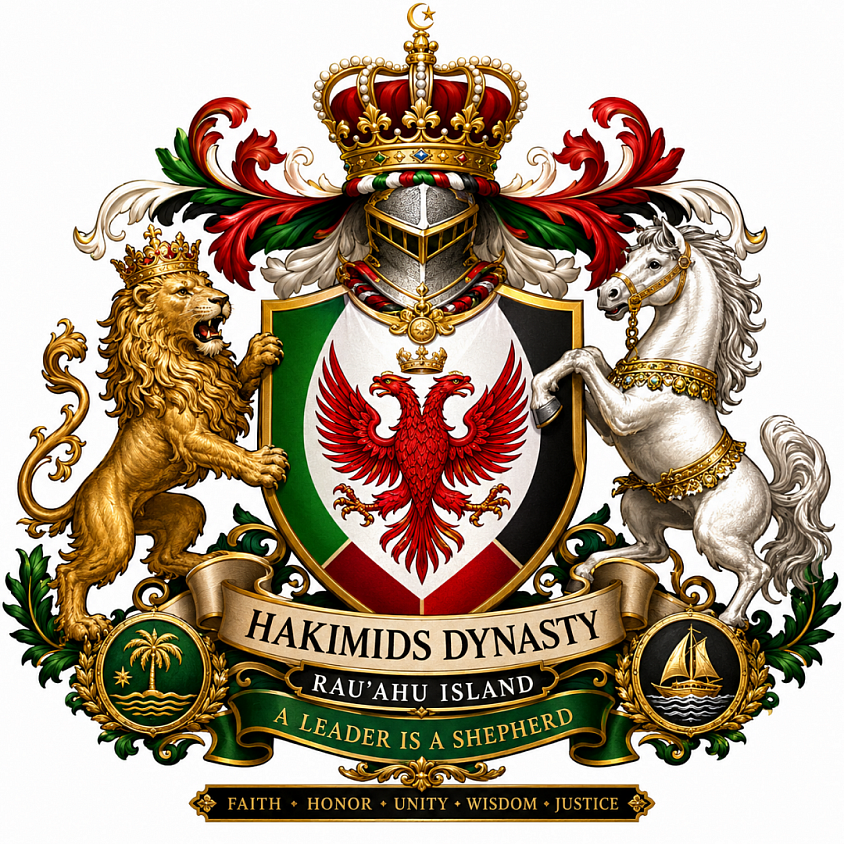
The Royal Coat of Arms of the Hakimids Dynasty can be understood not merely as a decorative emblem, but as a visual statement of identity, sovereignty, faith, responsibility, ancestry, and service. Each element can carry a deeper meaning.
Taken as a whole, the emblem tells a story:
The Moon–Star represents faith – Islam
The Crown represents leadership.
The Helmet represents duty.
The Shield represents protection.
The Eagle represents the Hakimids identity and vision.
The Lion represents courage.
The Horse represents noble progress.
The Island represents ancestral roots.
The Ship represents the continuing journey.
The Colors represent the fourfold identity of the dynasty.
The Shepherd's Motto defines the purpose of leadership.
The Five Virtues define the moral character expected of those who bear the Hakimids name.
The various features reflect the deeper meaning of the entire Coat of Arms.
Flag
Hakimids Flag
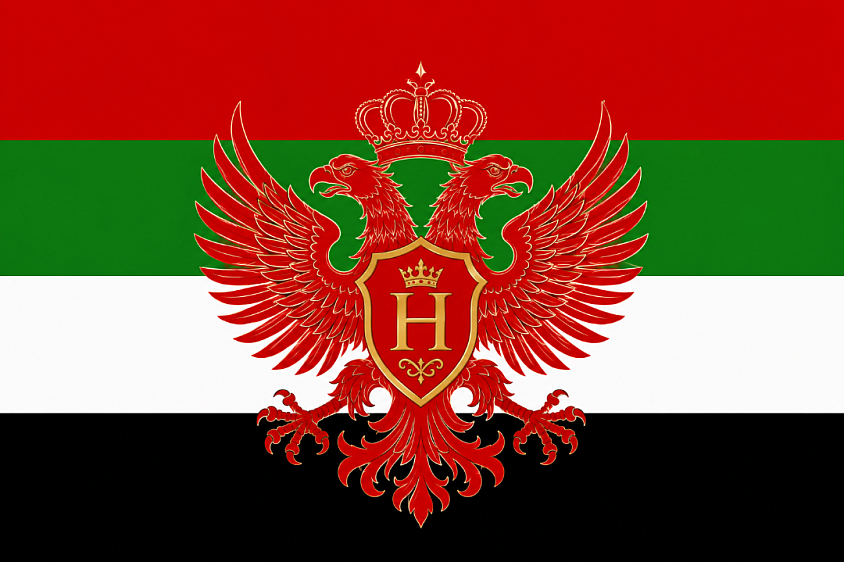
The Flag displays Colors of Identity
The Flag represents the colors associated with the Hakimids Family. These colors can carry symbolic meanings:
- Red: courage, sacrifice, and determination.
- Green: life, nature, growth, faith and hope.
- White: peace, purity, and honesty.
- Black: strength, dignity, and the remembrance of history.
The Flag, therefore, represents a balance between courage, life, peace, and resilience.
Double–Headed Eagle
Hakimids Double–Headed Eagle
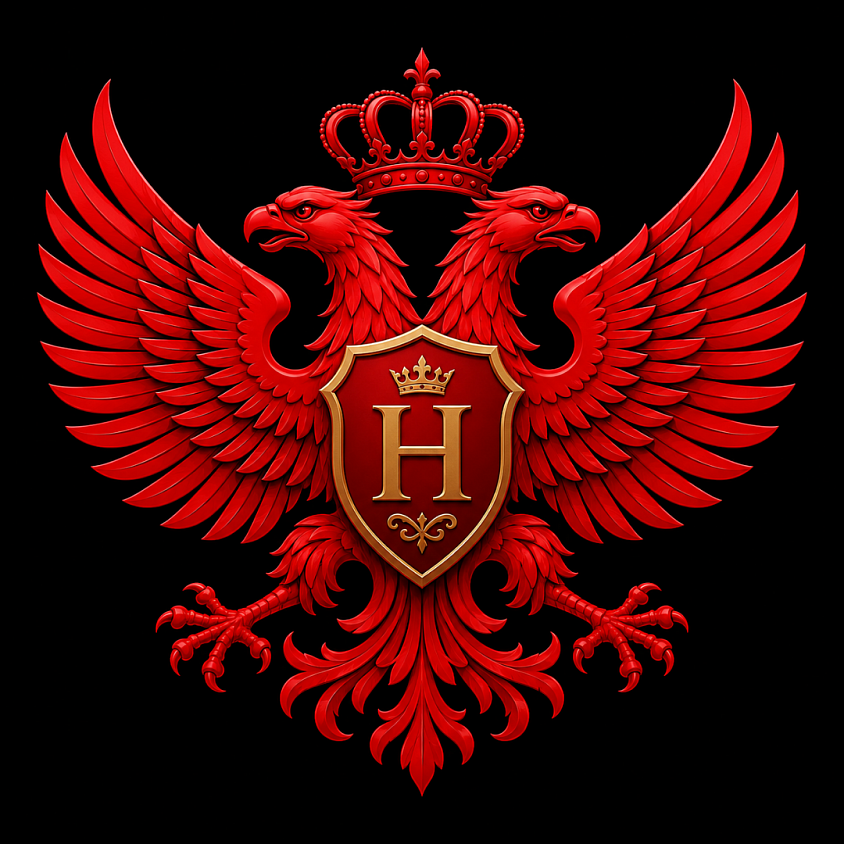
- Two-Headed Eagle — unity and dual responsibility:
The two heads can symbolize the ability of the Hakimids to look in two directions at once—honoring the family's ancestral past while looking toward its future. They can also represent wisdom, balance, and the responsibility to protect both family heritage and future generations.
- One Body — one family:
Although the eagle has two heads, it has one body and one heart. This can symbolize the unity of the Hakimids Family despite different branches, generations, and individuals.
- Outstretched Wings — protection:
The wide wings represent the family's duty to protect, guide, and care for its people, particularly the younger generations and descendants.
- Red Color — courage and sacrifice:
The red eagle can represent courage, strength, determination, honor, and sacrifice made for the family and its future.
- Eagle — leadership and vision:
The eagle's ability to rise above the earth and see from a great height symbolizes vision, wisdom, authority, and leadership.
Four Colors of Identity
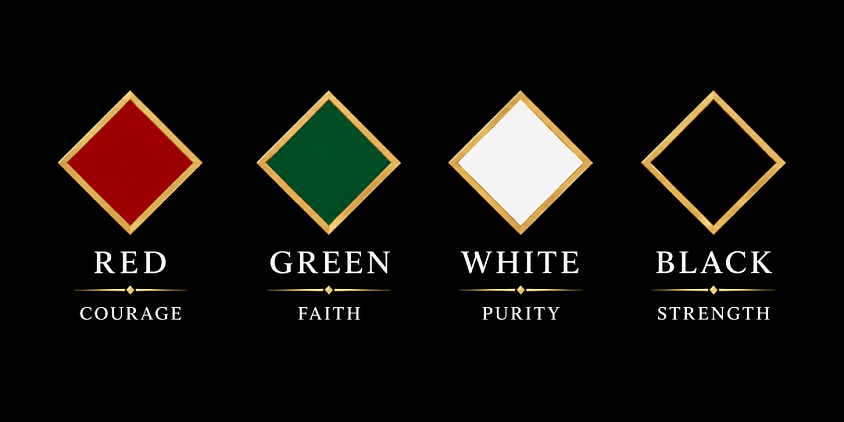
Hakimids Four Identity Colors
The Colors of Identity
The colors associated with the Hakimids Family carry symbolic meanings:
- Red — courage, sacrifice, and determination.
- Green — life, nature, growth, faith and hope.
- White — peace, purity, and honesty.
- Black — strength, dignity, and the remembrance of history.
Together, these colors represent a balance between courage, life, peace, and resilience.
Motto
The central motto associated with the Hakimids family is:
"A LEADER IS A SHEPHERD."
This motto expresses a concept of leadership based not primarily on domination, but on responsibility, protection, service, guidance, and moral accountability.
Explanation of the Symbolism
Meaning of the Hakimids Royal Coat of Arms
The Royal Coat of Arms of the Hakimids Dynasty can be understood not merely as a decorative emblem, but as a visual statement of identity, sovereignty, faith, responsibility, ancestry, and service. Each element can carry a deeper meaning.
1. THE GOLDEN MOON–STAR — Islam And Faith
The Hakimids system is primarily based on the Islamic principles of balance and justice.
“Surely, Allah commands justice, excellence, and generosity to relatives, and forbids immorality, wrongdoing, and oppression.” (Qur'an 16:91)
“All of you are shepherds, and each one of you is responsible for his own flock.” (Hadith – Prophet Muhammadsa)
A true leader is like a shepherd, and his leadership must build upon Faith, Honor, Unity, Wisdom, and Justice.
2. THE ROYAL CROWN — Sovereignty And Responsibility
The crown represents the royal dignity of the Hakimids Dynasty and its claim to leadership within the Rau’ahu tradition.
But the crown is not simply a symbol of power. It represents responsibility before God, family, and people. True royalty is therefore understood as stewardship rather than domination.
The crown's position above the shield signifies that leadership must be exercised with wisdom, justice, dignity, and restraint.
3. THE RED DOUBLE-HEADED EAGLE — The Central Identity
At the heart of the shield stands the red double-headed eagle, the principal symbol of the Hakimids.
Its two heads can represent:
• Past and future — remembering the ancestors while preparing for generations yet unborn.
• Tradition and progress — preserving heritage while advancing into the future.
• Wisdom and strength — intellectual authority joined with courage.
• Two horizons — the ability of leadership to look in more than one direction.
The eagle's wings extended outward symbolize aspiration, freedom, protection, and the expansion of responsibility.
Its red color represents courage, sacrifice, strength, and the bloodline of heritage.
4. THE SHIELD — Protection Of The Dynasty
The shield represents the family, territory, heritage, principles, and identity that the dynasty is entrusted to protect.
Its four principal colors carry complementary meanings:
Red — courage, sacrifice, authority, and ancestral heritage.
Green — life, faith, hope, prosperity, renewal, and the natural world.
White — purity, peace, truth, sincerity, and spiritual clarity.
Black — strength, dignity, endurance, and resilience through adversity.
Together, the four colors express a dynasty that seeks to unite strength with peace, authority with humility, and tradition with renewal.
5. THE GOLDEN LION — Courage And Justice
The lion represents courage, nobility, guardianship, and strength.
Its golden appearance adds the meaning of honor and royal dignity.
The lion stands beside the shield as a guardian, symbolizing the responsibility to defend what is valuable without allowing strength to become oppression.
6. THE WHITE HORSE — Nobility, Freedom, and Forward Movement
The white horse represents nobility, purity of intention, freedom, movement, and readiness to serve.
Unlike the lion, whose symbolism emphasizes strength and defense, the horse represents progress and purposeful movement toward the future.
Its white color reinforces the principles of peace, honesty, and righteous intention.
Together, the lion and horse create a balance:
Strength to defend; wisdom to advance.
7. THE HELMET — Protection And Duty
The armored helmet represents the idea that leadership requires readiness, discipline, courage, and protection.
It also reminds the bearer that a royal title is accompanied by duties. The ruler must be prepared to confront difficulties while remaining guided by higher principles.
8. THE RED, GREEN, WHITE, AND BLACK MANTLING — Continuity Of Identity
The flowing mantling surrounding the crown and helmet incorporates the Hakimids colors into the royal structure.
Its flowing form can symbolize the continuity of the dynasty through generations—heritage passed from ancestors to descendants.
The colors are therefore not merely aesthetic. They form a visual language of Hakimids identity.
9. THE ISLAND EMBLEM — Rau’ahu And Ancestral Homeland
The palm tree, land, and water represented in the circular emblem symbolize Rau’ahu Island and the ancestral homeland.
The palm can signify:
• rootedness,
• survival,
• life,
• fertility,
• resilience,
• and connection to the land.
Its roots are a reminder that a dynasty cannot understand its future without remembering where its story began.
10. THE SHIP — Journey And Destiny
The ship represents voyage, exploration, migration, and the journey of generations.
For an island-based heritage, the sea is particularly significant. It can symbolize both the physical environment and the unknown future across which succeeding generations must navigate.
The ship therefore carries a profound message:
The dynasty has roots in the past, but its journey continues toward the future.
11. THE GREEN WREATH — Life And Continuity
The surrounding leaves represent life, growth, fertility, renewal, and continuity.
The wreath encircles the lower part of the arms as though protecting the heritage contained within it.
It also connects the royal emblem with the natural world of the island.
12. “HAKIMIDS DYNASTY” — Identity
The principal banner establishes the name of the institution:
HAKIMIDS DYNASTY
It declares that the coat of arms belongs to a distinct family and dynastic identity.
13. “RAU’AHU ISLAND” — Origin
The second banner establishes the geographical and ancestral association:
RAU’AHU ISLAND
This gives the coat of arms a sense of place, origin, belonging, and historical memory.
14. “A LEADER IS A SHEPHERD” — The Philosophy Of Leadership
This is perhaps the most important philosophical statement on the entire coat of arms.
“A LEADER IS A SHEPHERD.”
The shepherd does not merely command the flock. He guides, protects, feeds, searches for the lost, and accepts responsibility for those entrusted to him.
Therefore, the Hakimids conception of royalty can be expressed as:
Authority exists for service; leadership exists for protection; and honor exists for responsibility.
This transforms the crown from a symbol of privilege into a symbol of service.
15. “FAITH • HONOR • UNITY • WISDOM • JUSTICE”
The five principles at the bottom can function as the moral foundation of the dynasty:
Faith — recognition of God and accountability before Him.
Honor — integrity, dignity, and keeping one's word.
Unity — preserving family solidarity and communal harmony.
Wisdom— governing through knowledge, reflection, and discernment.
Justice — giving every person their rightful due without oppression or favoritism.
These five principles provide a moral counterbalance to royal authority.
In its deepest sense, the Coat of Arms declares:
“We remember our origins, protect our heritage, seek wisdom, uphold justice, preserve unity, and look toward the future—not merely as rulers, but as shepherds entrusted with a people and a legacy.”
This makes the double-headed red eagle at the center especially powerful: everything else surrounds and supports the central identity, while the eagle itself looks simultaneously toward what has been inherited and what must still be built.
Meaning of the Hakimids Double-Headed Eagle
- Two Heads — unity and dual responsibility:
The two heads can symbolize the ability of the Hakimids to look in two directions at once—honoring the family's ancestral past while looking toward its future. They can also represent wisdom, balance, and the responsibility to protect both family heritage and future generations.
- One Body — one family:
Although the eagle has two heads, it has one body and one heart. This can symbolize the unity of the Hakimids Family despite different branches, generations, and individuals.
- Outstretched Wings — protection:
The wide wings represent the family's duty to protect, guide, and care for its people, particularly the younger generations and descendants.
- Red color — courage and sacrifice:
The red eagle can represent courage, strength, determination, honor, and sacrifice made for the family and its future.
- Eagle — leadership and vision:
The eagle's ability to rise above the earth and see from a great height symbolizes vision, wisdom, authority, and leadership.
Together, these colors represent a balance between courage, life, peace, and resilience.
Importantly, these meanings are symbolic meanings established for the Hakimids, rather than claiming that every historical use of the double-headed eagle has the same meaning.
The Four Hakimids Colors
The four colors can also carry a distinct identity:
Red — Courage and leadership
Green — Life, land, growth, faith and hope
White — Peace, truth, purity, and justice
Black — Strength, dignity, endurance, and ancestral heritage
Together, the four colors and the red double-headed eagle form a visual identity for the Hakimids Family: a united family rooted in its heritage, guided by wisdom, committed to protection and justice, and looking toward the future.